
How to Prevent Tile Cracks During Installation

How to Prevent Tile Cracks During Installation
Complete guide to safe work with a vacuum lifter — for GECO 200, GECO 300 and GECO 300 PRO
GECO 200 and GECO 300 are electric hand-operated lifters used by one or two workers. GECO 300 PRO is a hydraulic attachment for excavators — controlled entirely from the operator's cab.
Jerking or impact
A sudden lift, rapid swing of the excavator arm or careless lowering generates dynamic forces many times greater than the static weight of the slab.
Poor centring
A slab supported off-centre bends like a beam on two supports. Even a short transport in this position creates tensile stress on the underside sufficient to cause cracking.
Dirty contact surface
A grain of sand or a mortar crumb under the seal acts as a pressure point. It concentrates the entire suction force on an area smaller than a square millimetre — enough to exceed the strength of the glaze or material.
Worn seal
Old rubber hardens, loses elasticity and stops absorbing vibrations from the motor or excavator arm. Instead of distributing force evenly, it creates localised stress concentrators.
Important: Cracks are not always immediately visible. Micro-cracks on the underside may be hidden after installation, but appear weeks later under the influence of frost, moisture or movement. Always follow safe installation practice even if slabs look undamaged at first glance.
Centre on the slab's centre of gravity
Before attaching the lifter, find the geometric centre of the slab — the intersection of the diagonals for rectangles. Do a test attachment at low vacuum and check that the slab lifts level. Any tilt greater than 5° indicates poor centring.
Clean the contact surface
Before every lift, wipe or blow dust, sand and mortar residue off the slab surface. Pay special attention to slabs taken directly from pallets or lying on a bed of grit. Even minor contamination blocks the seal and creates stress concentration points under the suction pad.
Move smoothly — no jerks
Sudden lifting, abrupt stops or fast rotation generate dynamic overloads 3–5× higher than the slab's static weight. With GECO 200 and 300 — control movement speed with your hands. With GECO 300 PRO — the excavator operator should use minimum arm speeds throughout the entire load transfer.
Match vacuum to the material
Too low vacuum risks dropping the slab; too high can damage delicate materials. Ceramic and concrete slabs tolerate higher values; natural stone and thin porcelain need gentler settings. The built-in vacuum gauge in GECO 200 and 300 lets you monitor the working value in real time.
Inspect seals regularly
Rubber seals age under UV, frost and suction cycles. A worn seal hardens, loses damping ability and no longer conforms to surface micro-roughness. Visually inspect before every shift. Replace the seal if you see indentations, cracks or permanent deformation.
Set down gently — only then release vacuum
Never release vacuum while the slab is still in the air or being lowered. First align it precisely over the target position, lower it slowly to full contact with the surface, and only then release the suction pads. Releasing vacuum too early can cause the slab to drop or shift with lateral forces — enough to crack a corner.
Pro tip: For challenging slabs (thin, large-format, natural stone) always use both suction pads from the GECO 200 or 300 kit, placed symmetrically along the slab's long axis. This increases the contact area and reduces bending during transport by up to 60%.
GECO 200
- Ideal for 2 cm porcelain and ceramic tiles
- Vacuum gauge with audible alarm
- Precise manual centring — easy control
- Excellent on terraces, balconies, narrow spaces
- Full control of lowering speed
- Interchangeable suction pads for different formats
GECO 300
- For heavy concrete and large-format slabs
- Vacuum gauge with audible alarm
- Precise manual centring — easy control
- Ideal for kerb stones and concrete precast elements
- More powerful vacuum pump than model 200
- Interchangeable suction pads for different formats
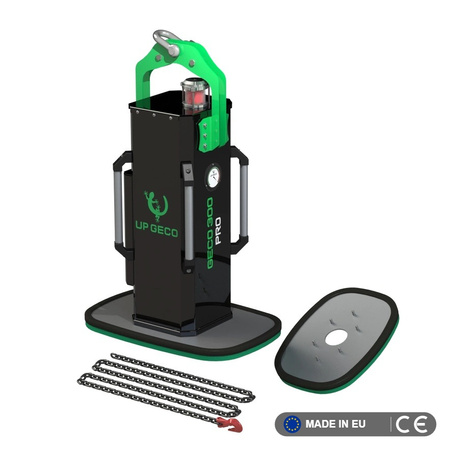
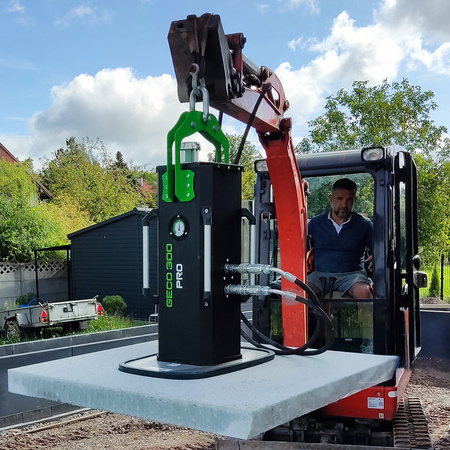
GECO 300 PRO
- Mounts on excavator or mini-excavator arm
- Full control from the cab — no manual handling
- Hydraulic power — no electrical failures
- Reduces installation time by up to 50%
- Key: slow arm movements to protect slabs
- Interchangeable pads: 400×300 mm and 600×375 mm
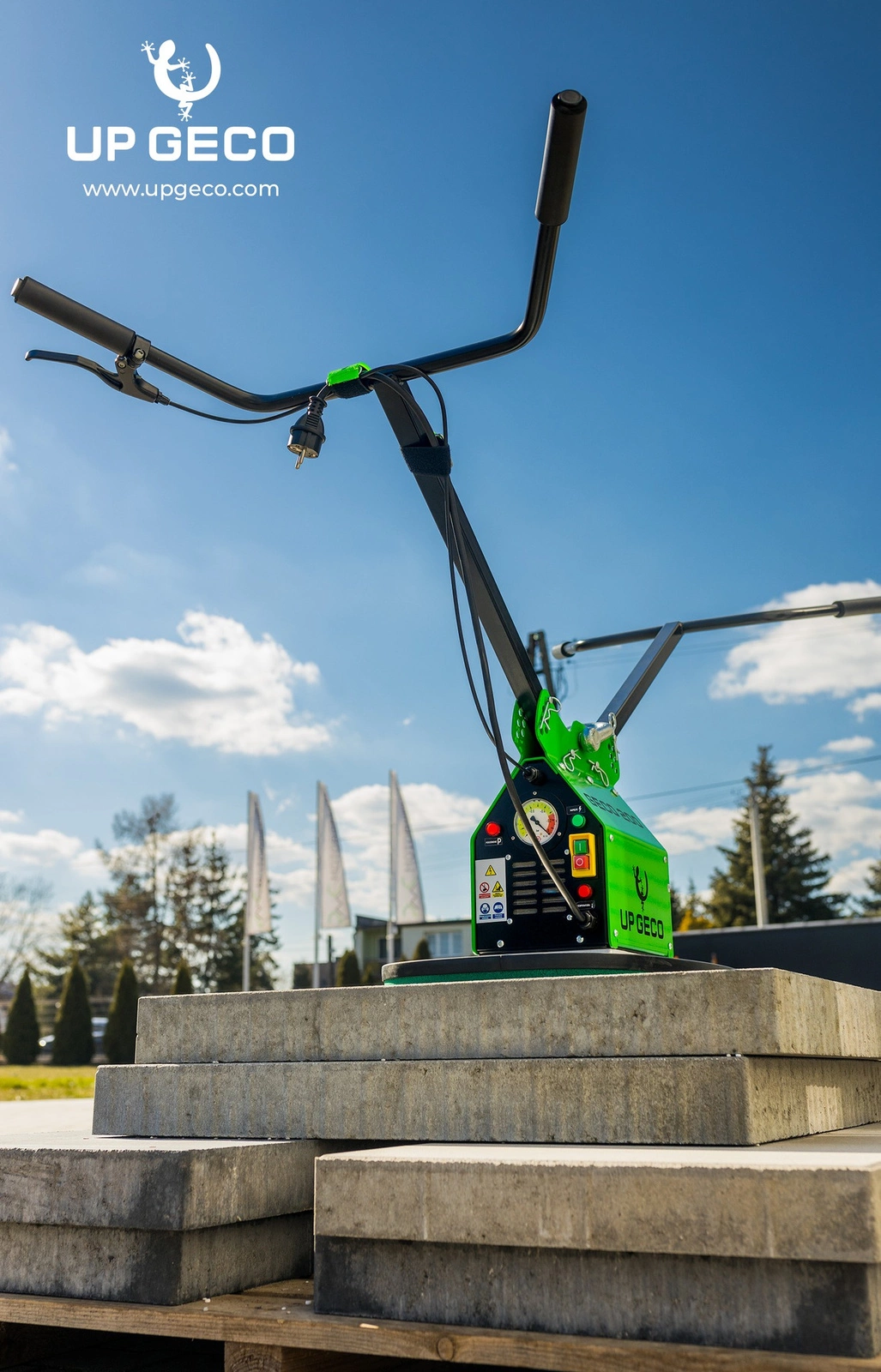
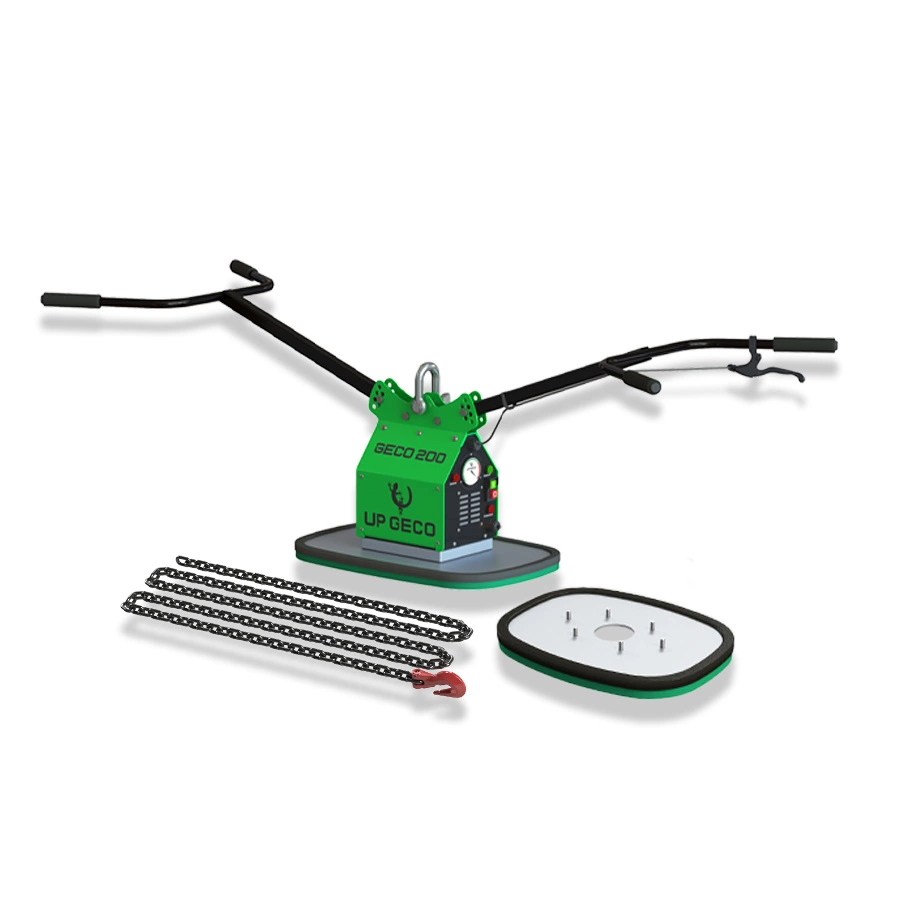
GECO 200 Vacuum Lifter
Electric hand lifter for porcelain and ceramic slabs up to 200 kg. Vacuum gauge, audible alarm, interchangeable suction pads. Supplied with suction plates.
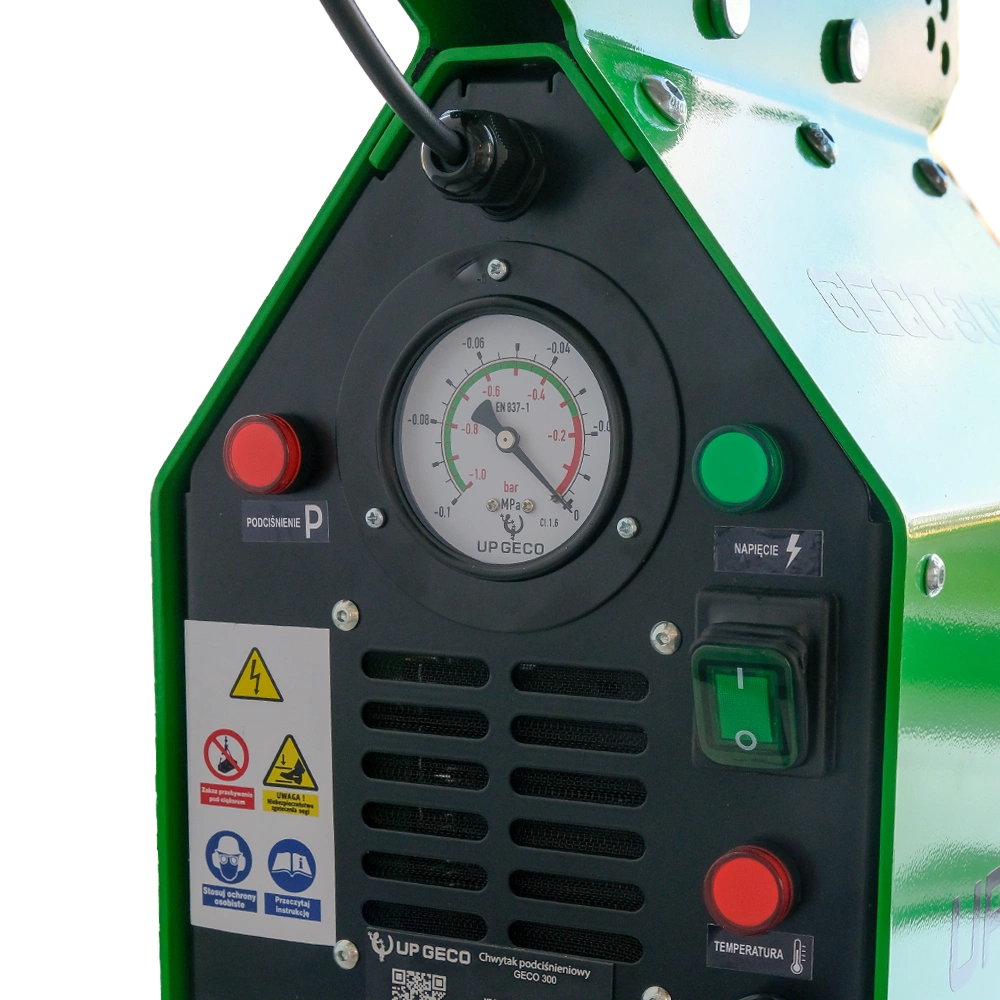
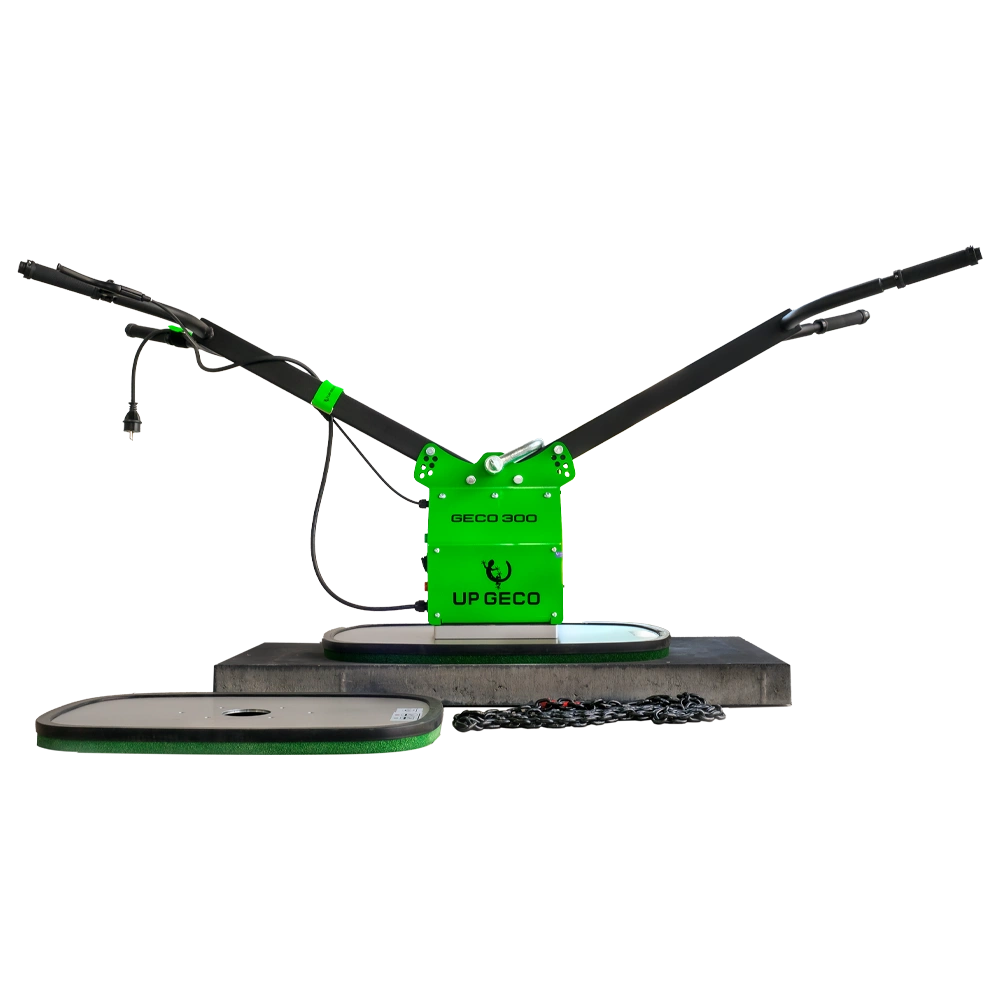
GECO 300 Vacuum Lifter
Electric hand lifter for heavy concrete and large-format slabs up to 300 kg. More powerful pump, vacuum gauge, audible alarm. Supplied with suction plates.
GECO 300 PRO – for excavators
Hydraulic attachment for excavators and mini-excavators. Cab-operated, up to 300 kg, working pressure 150 bar, min. oil flow 20 L/min. Includes two suction plates.
Ready to install without cracks?
Choose the GECO model for your work — electric for hand installation or hydraulic for the excavator. Made in Poland, CE certified, service on demand.
GECO 200 – 1 703,41 € GECO 300 – 2 271,22 € GECO 300 PRO – 3 217,56 €