
Substrate for Terrace and Garden Paths
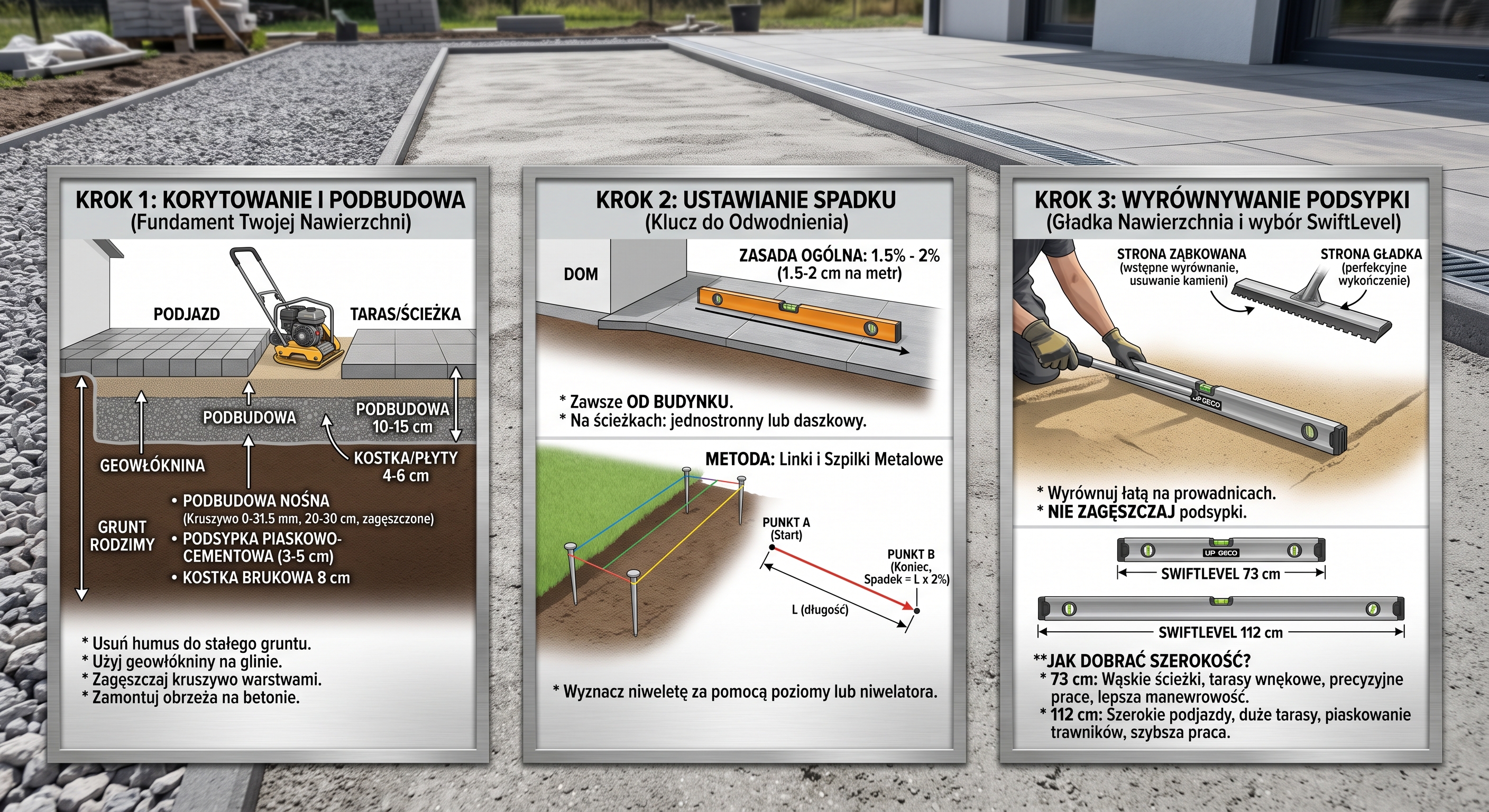
Substrate for Terrace and Garden Paths – SwiftLevel 112 cm and 73 cm Levelling Board
Terrace, driveway, garden path – here every millimetre counts: the right drainage slope, a stable substrate under every slab, and a surface that lasts for decades. SwiftLevel 112 cm vs. 73 cm compared – which model to choose and how to use it.
Preparing the substrate for a terrace or garden path is not the same as levelling a lawn. Every slab, every paving stone and every stepping stone must rest on a precisely prepared layer of sand or grit with the correct drainage gradient. A mistake at the substrate stage means standing water, uneven slabs and ground movement over time. The SwiftLevel screed board – with its full-width stabilising roller and double-sided blade – lets you achieve the required precision faster and more reliably than traditional methods. Below you'll find a complete guide: which model to choose, how to set the slope and how to prepare the perfect terrace or path substrate step by step.
Why do terraces and garden paths demand more precision than a lawn?
Four reasons why terrace substrate preparation is a more demanding task than general garden levelling
±2 mm tolerance under a 2 m straight edge
The standard for terrace slab substrate requires a flatness tolerance of ±2 mm under a 2 m straight edge – three times stricter than general ground levelling. The SwiftLevel board with its stabilising roller lets you hit this tolerance without specialist equipment.
Drainage slope – essential on every terrace
A house terrace must have a gradient of at least 1–2 cm per linear metre, away from the façade. Without it, water pools against the foundations and damages waterproofing. SwiftLevel lets you maintain a consistent slope across the full terrace width in a single pass.
Stability under every slab
A slab with a hollow beneath it (even 5 mm) flexes under load and cracks. The SwiftLevel stabilising roller compacts sand and grit below the surface, eliminating micro-depressions that are invisible to the naked eye but show up only once the paving is laid.
Narrow strips – perfect for the 73 cm model
A standard garden path is 60–120 cm wide, and the SwiftLevel 73 cm working width is exactly 73 cm. One pass equals one fully levelled path. With the 112 cm model you cover more ground per pass, but in a narrow path there simply isn't room to manoeuvre.
SwiftLevel 73 cm – built for garden paths
A standard garden path is 80–120 cm wide. The SwiftLevel 73 cm, with its 73 cm working width, fits inside a standard path without having to fight the edging restraints. One toothed pass, one smooth pass – the path is done. Compared to the 112 cm model, the 73 cm gives you three times more clearance in a tight passage.
SwiftLevel 112 cm vs. 73 cm – choosing for terraces and paths
Full comparison table with a recommendation for every application
| Feature | SwiftLevel 112 cm | SwiftLevel 73 cm |
|---|---|---|
| Working width | 112 cm | 73 cm |
| Weight | ~10 kg | ~7 kg |
| House terrace (<30 m²) | Good | Better – less manoeuvring |
| Freestanding terrace (>30 m²) | Better – fewer passes | Good |
| Garden path 80–120 cm | Possible | Ideal – 1 pass = 1 path |
| Wide path >130 cm | Better | Good |
| Working at walls / edging | More difficult | Easier – more agile |
| Maintaining drainage slope | Yes | Yes |
| Certification | CE, Made in EU | CE, Made in EU |
| Warranty | 1 year manufacturer | 1 year manufacturer |
| Net price | 189,27 € | 94,63 € |
Which model should you choose for your project?
Four typical scenarios – from a house terrace to a wide garden alley
Terrace next to the house or façade (up to 30 m²)
Limited space, work close to the wall, precise drainage slope required. The SwiftLevel 73 cm fits into every corner, manoeuvres easily in tight angles and lets you level the strip along the façade without risking damage to the plinth.
✓ SwiftLevel 73 cmLarge terrace or patio (over 30 m²)
Freestanding terrace, garden patio, concrete slab plaza. No wall constraints, more room to manoeuvre. The SwiftLevel 112 cm covers the same area faster – fewer passes and a more uniform layer across a large surface.
✓ SwiftLevel 112 cmGarden path or alley (80–200 cm width)
Classic garden path, alley between flowerbeds, passage along a fence. For paths up to about 130 cm wide the SwiftLevel 73 cm fits perfectly and lets you work without constantly correcting direction against the edging.
✓ SwiftLevel 73 cmDriveway + terrace + paths (comprehensive project)
Large projects: garage driveway, terrace, several garden paths. The 112 cm handles the driveway and large terrace; the 73 cm gets into narrow alleys and façade zones. Professional paving crews often use both boards simultaneously.
✓ Both modelsThree SwiftLevel functions – each essential for terrace work
Double-sided blade and stabilising roller in one tool
Toothed blade – breaking up and initial spreading
The first contact edge. The teeth loosen compacted aggregate, break up clods and draw stones to the surface. On a terrace this means you don't have to manually sieve and break up material before levelling – the board does it on the first pass.
Smooth blade – precision levelling with consistent slope
Flip the board and set the final bed. The smooth blade cuts through sand or grit in a perfectly flat layer, eliminates all micro-irregularities and maintains the drainage angle throughout the entire pass – critical on a terrace where no correction is possible once slabs are laid.
Stabilising roller – compaction and constant bed contact
The full-width roller works together with the blade: it maintains consistent downward pressure across the entire board width while pre-compacting the sand or grit. On a terrace this eliminates micro-depressions that only show up as rocking slabs underfoot once the paving is in place.
Step by step: preparing the substrate for a terrace and garden paths
Professional workflow – from excavation to the finished screed layer
Excavation and sub-grade stabilisation
Excavate to at least 20–30 cm depth (surface terrace) or 15–20 cm (path). Compact the sub-grade with a plate compactor or small roller.
Hardcore or crushed stone base
Spread and compact crushed stone 0–31.5 mm to a depth of 10–15 cm. This is the foundation for drainage and structural stability. For house terraces, lay a separating geotextile between the sub-grade and the base.
Setting the drainage slope
Set levelling pins (spikes/lines) at 1–2 cm per linear metre, sloping away from the façade or towards the drain. Check with a spirit level or laser level.
Spread sand or bedding mix
Spread coarse sand (0–5 mm) or a dry cement–sand mix (1:4) evenly to a depth of 3–5 cm. No need to level it at this stage – SwiftLevel will do it in two passes.
Two SwiftLevel passes
Pass 1: toothed blade down – breaking up and initial levelling. Remove stones and clods. Pass 2: smooth blade – final levelling maintaining the pin slope. Check with a spirit level.
Inspection and correction before laying
Place a 2 m straight edge in several directions – gap must not exceed 2–3 mm. Check slope angle over 1 linear metre (should show 1–2 cm difference). Correct any areas where the board dipped or lifted.
Every terrace and path must have a gradient that drains rainwater. Too little = puddles and frost damage. Too much = uncomfortable walking. Recommended values:
Drive two levelling pins (or metal pipes) along the terrace, spaced exactly the board width apart. Set them to the correct heights for the required slope (e.g. 2 cm difference per 1 m run). Guide the SwiftLevel board resting both ends on the pipes – you achieve a perfectly uniform slope across the full terrace width without a laser level. This is the technique used by professional paving crews when laying bedding layers under slabs.
Concrete and stone slabs require a sand bedding layer of 3–5 cm on a compacted sub-base. Decorative gravel and chippings only need a uniformly compacted gravel layer held by edge restraints. Composite decking boards are mounted on steel subframes without sand bedding. In all cases, SwiftLevel is the right tool for preparing and levelling the final layer before laying the surface.
Technical specifications – both models
Product data confirmed by the manufacturer UP GECO
| Parameter | SwiftLevel 112 cm | SwiftLevel 73 cm |
|---|---|---|
| Working width | 112 cm | 73 cm |
| Total height | 182.5 cm | 182.5 cm |
| Total weight | ~10 kg | ~7 kg |
| Blade material | Steel S355, 5 mm thick | Steel S355, 5 mm thick |
| Corrosion protection | Powder coating | Powder coating |
| Handle | Beech wood, Ø 28 mm | Beech wood, Ø 28 mm |
| Handle adjustment | Two-step | Two-step |
| Working edge | Double-sided (toothed + smooth) | Double-sided (toothed + smooth) |
| Stabilising roller | Full-width, 112 cm | Full-width, 73 cm |
| Certification | CE | CE |
| Country of manufacture | Poland – Made in EU | Poland – Made in EU |
| Warranty | 1 year manufacturer | 1 year manufacturer |
| Net price | 189,27 € | 94,63 € |
Choose your SwiftLevel board for terraces and garden paths
Paths and house terrace – SwiftLevel 73 cm. Large terraces and driveways – SwiftLevel 112 cm.
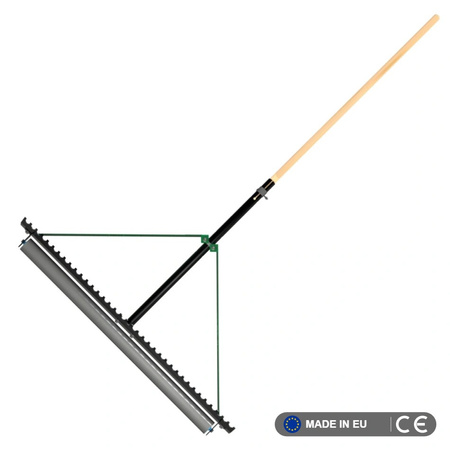
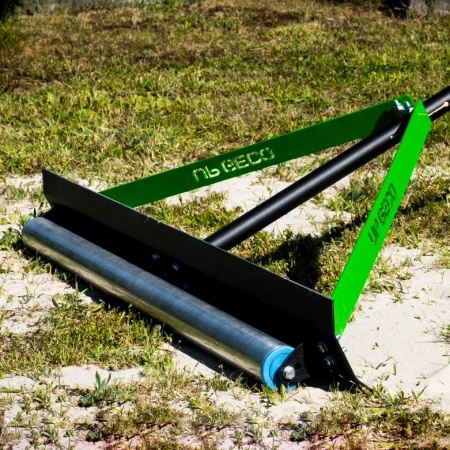
SwiftLevel 112 cm Levelling Board
112 cm working width, full-width stabilising roller, toothed + smooth blade, adjustable beech handle, S355 steel 5 mm powder coated. Made in EU, CE, 1-year warranty.
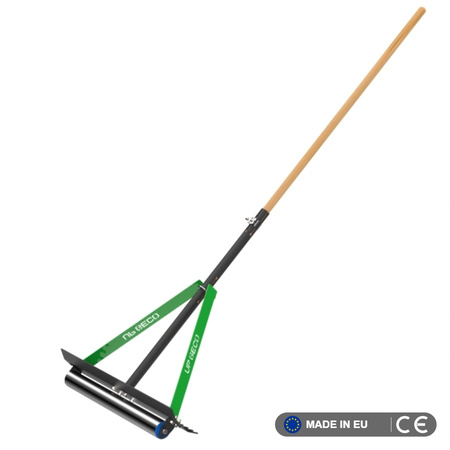
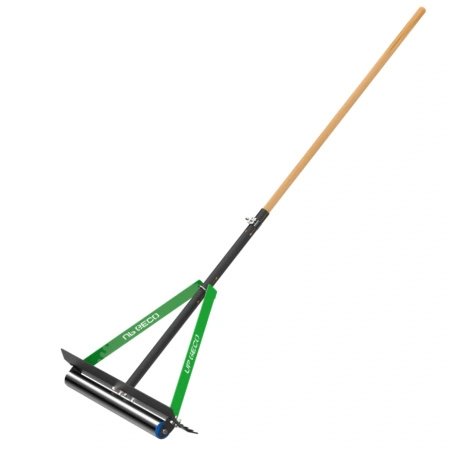
SwiftLevel 73 cm Levelling Board
73 cm working width – perfect for standard garden paths 80–120 cm wide. Stabilising roller, toothed + smooth blade, adjustable beech handle, S355 steel 5 mm. Lighter (~7 kg), easier to use in tight spaces. Made in EU, CE, 1-year warranty.
Frequently Asked Questions
Answers to questions about substrate preparation for terraces and garden paths
Prepare your terrace and garden path substrate with professional precision
SwiftLevel 73 cm for garden paths and terraces next to the house. SwiftLevel 112 cm for large terraces and driveways. Both – Made in EU, CE certified, 1-year warranty with free courier collection.